July 2026
Predator Control at Pupu Rangi: What the Conservation Work Involves
Conservation in New Zealand has a gentle public image — planting native trees, listening for birds at dawn, the occasional photo of a kiwi chick. Much of the work that makes those images possible happen behind the scenes and it is quieter and less photogenic: protecting native species here means controlling the introduced predators that prey on them. That involves killing those predators, mainly by trapping. You might have done your own research and know this already, this blog entry will explain this side of conservation such that those of you arriving here have a clear picture of it.
Why It Is Necessary
New Zealand spent 80 million years with no land mammals. Its birds, insects, snails, and bats evolved with nothing to run from — many of them are flightless, ground-nesting, and slow, with no defences against an animal that hunts by scent and speed. When people (relatively recently) arrived and brought stoats, rats, possums, and ferrets with them, native wildlife had no way to cope, and the sharp decline that followed is still going on today. Stoats are the main reason most wild kiwi chicks never reach adulthood. Rats eat most of the seeds that fall on the forest floor, they take eggs and chicks; possums strip the forest the birds depend on. Left unmanaged, these introduced animals don't settle into a natural balance with native species — the native species simply disappear.
There isn't a version of protecting this forest that leaves the predators in it. Trapping and baiting are the methods that work and they are the same ones used across the country, including by the New Zealand Department of Conservation. If you'd like the wider picture, DOC's introduction to conservation is a good starting point. The position is a simple one: protecting these species means removing the animals that eat them.
This isn't unique to New Zealand. The same work is happening quietly in nature reserves around the world — most people just never see it. In Germany, hunters kill over 200,000 raccoons a year — raccoons introduced in the 1930s that are now the largest population outside North America, and a serious threat to ground-nesting birds and native wildlife. In British Columbia, the provincial government has been shooting wolves from helicopters every winter since 2015 — over 1,900 killed to date — because without predator control, southern mountain caribou herds collapse. In the Orkney Islands in Scotland, the largest stoat eradication program ever attempted on an inhabited landscape is currently underway: 8,000 trap boxes — most of them loaded with DOC 200 traps, the same New Zealand-designed trap we use here — deployed to protect ground-nesting birds that stoats, not native to Orkney, had been decimating. On the island of Ventotene off the Italian coast, an entire island was cleared of black rats; within four years, the breeding success of local seabirds went from around 10% to over 90%. In western France, close to 300,000 invasive coypu and muskrats are removed from waterways every year to prevent the collapse of riverbanks and wetland habitat. None of this makes the news. It just makes the forests and rivers work.
What the Work Involves
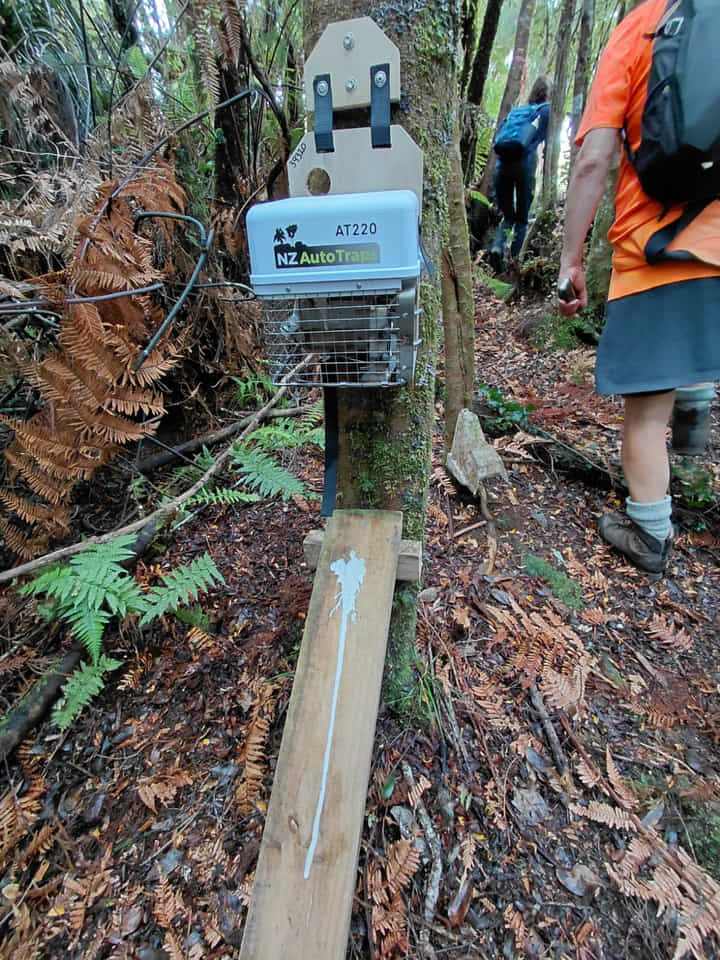
In practice, predator control is steady and methodical rather than dramatic. It means walking trap lines through the bush, checking and resetting traps, refilling bait stations, and keeping careful records so the effort can be measured over years rather than days. It is unglamorous, repetitive, and quietly satisfying when the numbers move in the right direction. It also means coming into contact with the reality of it: this is hands-on work and the instant-kill traps do what they are designed to do. We don't dwell on that, but we don't hide it either. The trap we use — the DOC 200 — was designed here in New Zealand specifically for this purpose. It is now used on conservation projects around the world, including the Orkney stoat program mentioned above.
For volunteers and interns, this is a regular, central part of the work. One-week Immersion participants don't take part in the trapping itself, though they live and work alongside it and come to understand why it's done.
Something to Consider Before You Apply
We explain all this for one reason: so the people who join are choosing it knowingly. For most people who care about nature, predator control makes sense quite quickly — once you've seen a forest start to recover, the logic becomes concrete. But it isn't for everyone and that's completely understandable. Some people, including many vegans and others who care deeply about animals, would simply rather not take part in deliberately killing them, introduced or not. If that's you, it is far better to know it before committing to a trip across the world.
There's no judgement either way. Conservation in a place like this asks you to hold two things together: that every animal matters and that protecting vulnerable native species sometimes depends on removing the ones that prey on them. People who can accept that tend to find the work among the most meaningful they have done. People who can't are better served by one of the many gentler ways to spend time in nature and there is no harm at all in deciding this isn't your path.
One more thought worth leaving you with. The next time you walk through a beautiful forest here in New Zealand there is a reasonable chance that someone has been out there ahead of you, checking traps and maintaining bait stations so that what you are walking through still resembles a functioning ecosystem. It mostly happens invisibly, by people who don't need the credit. That is what this work is.
If the reasoning makes sense to you, take a look at our volunteer program, or get in touch with any questions — we're always glad to talk it through before you decide.